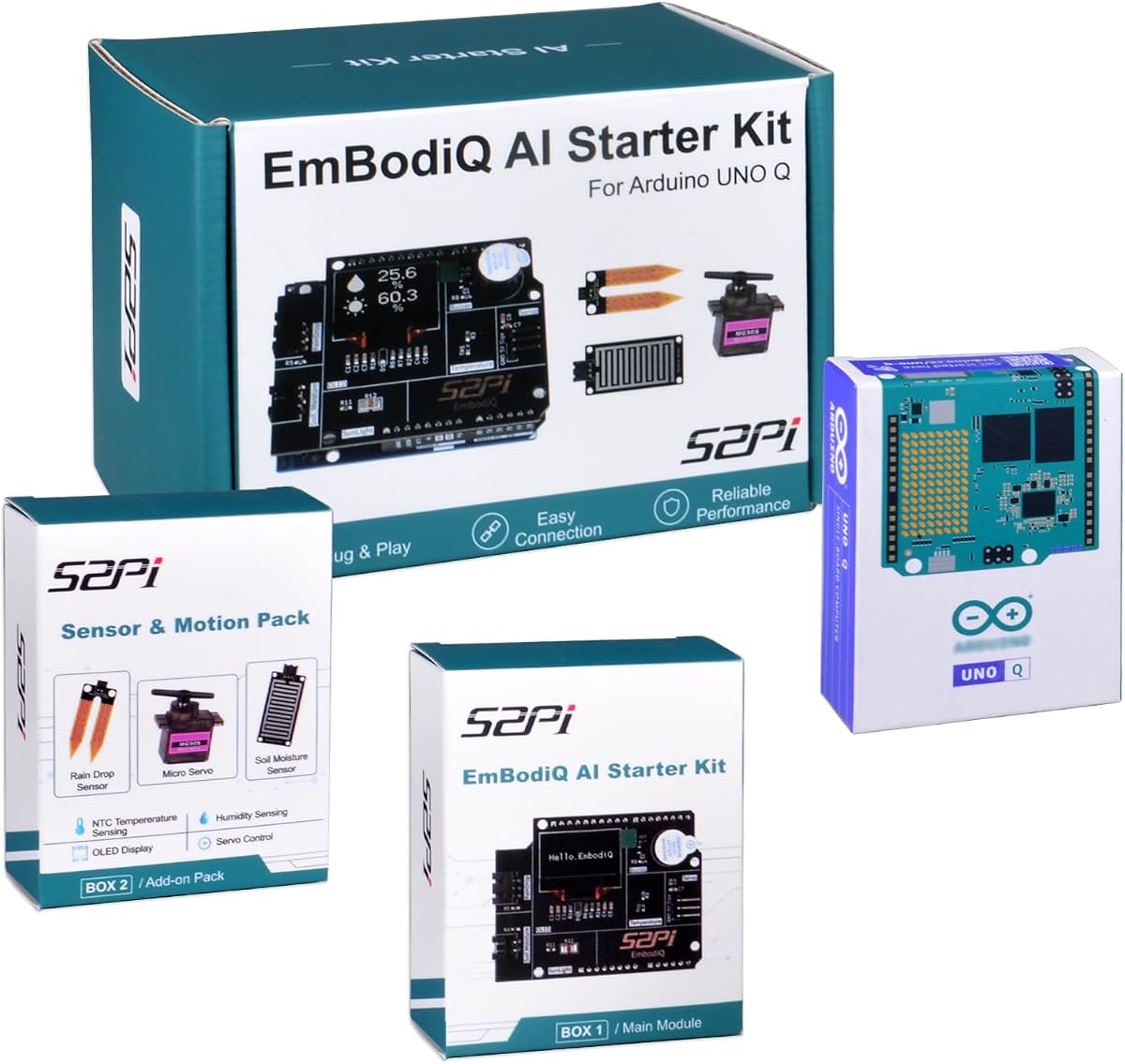
GeeekPi EmbodiQ AI Starter Kit
3.7Editor score
Natural language control features
AI Agent HAT included
Complete sensor suite provided
This guide compares the best Arduino Uno Q boards and kits for AI, robotics, and embedded development in October 2026 based on performance and features.
The Arduino Uno Q represents a significant leap forward in microcontroller technology by merging traditional Arduino compatibility with powerful Linux capabilities and AI processing. This hybrid approach allows developers to run complex machine learning models directly on the edge while maintaining the familiar ecosystem of shields and libraries that makers love. It opens new doors for robotics, IoT, and smart automation projects that require both real-time control and advanced data processing.
We have carefully evaluated ten top products to help you find the perfect solution for your specific development needs. Our comparison includes official boards, starter kits, and compatible alternatives that offer different levels of performance, connectivity, and accessory support. Each entry was analyzed based on processor power, memory capacity, software support, and ease of integration into existing workflows.
Every product in this list highlights unique strengths tailored to different user groups ranging from students to professional engineers. Please note that pricing and availability can fluctuate frequently so we recommend verifying current details before making your final purchase decision. This guide aims to provide clear insights so you can confidently choose the board that best fits your project requirements.
3.7Editor score

4.4Editor score

4.8Editor score
This side-by-side comparison highlights the key specifications and capabilities of each product to help you quickly identify the right fit for your projects.


The Arduino® UNO™ Q 4GB stands out as the most versatile hybrid board available in November 2026, earning its top rank through its unique dual-brain architecture. With a rating of 4.4 stars from early adopters, it delivers on its promise to bridge the gap between simple microcontroller projects and advanced computing tasks. Its ability to run Debian Linux alongside real-time MCU code makes it ideal for complex IoT and robotics applications.
We may earn a commission when you buy through this link, at no additional cost to you.
Key strengths include the Qualcomm Dragonwing QRB2210 processor which handles AI acceleration and high-level tasks while the STM32U585 manages low-power real-time control. This separation of duties ensures that your robotic arms or voice recognition systems run smoothly without lag. The inclusion of 4GB RAM and 32GB storage allows you to run multiple processes simultaneously, a feature unheard of in standard Arduino boards.
Honest trade-offs involve the need for a dedicated power supply and slightly more complex setup compared to traditional boards. You may need to familiarize yourself with Linux terminal commands if you plan to fully utilize the OS features. However, these complexities are acceptable given the massive performance leap and the ability to integrate containerized AI models directly into your workflow.
Engineers and advanced hobbyists building smart cameras or autonomous robots should buy this board first. It provides a unified interface to mix Arduino Sketches Python scripts and AI models effectively. This recommendation ensures you have the hardware necessary to tackle next-generation edge AI projects without needing separate computers.
Combining an ARM Cortex-A53 CPU with a dedicated microcontroller allows for simultaneous high-level processing and real-time control without resource conflicts.
The classic UNO form factor ensures you can reuse existing shields and libraries while gaining access to modern Linux-based development tools.
We may earn a commission when you buy through this link, at no additional cost to you.
This variant of the Arduino UNO Q bundles the board with a 45W USB-C power supply ensuring stable operation under heavy workloads. Rated highly by developers who value reliability, this kit removes the guesswork of finding the right power adapter. It is designed specifically for those who need consistent performance for industrial IoT systems and scalable robotics projects.
We may earn a commission when you buy through this link, at no additional cost to you.
The board maintains the same powerful dual-brain architecture as the standalone version making it perfect for multitasking high-performance computing tasks. The included power supply handles the peak current demands of the quad-core processor during intensive AI inference. This setup is particularly beneficial for deployments where power fluctuations could cause system instability or crashes.
While it offers excellent core performance, it does not include additional sensors or cases which might be needed for immediate prototyping. You may need to source your own cables and protective housing separately. This trade-off is acceptable for professionals who already have their own testing equipment and prefer to customize their setup.
Professional developers building scalable robotics and industrial IoT systems should purchase this bundle. The reliable power delivery ensures that your projects run smoothly in demanding environments. This choice maximizes uptime and performance for applications where consistent power is critical for mission-critical operations.
The included 45W adapter ensures that the high-performance processors receive stable voltage even when running complex machine learning models simultaneously.
Designed for engineers who need a foundation that can grow into larger distributed systems with reliable wireless and processing capabilities.
We may earn a commission when you buy through this link, at no additional cost to you.
The GeeekPi Starter Kit provides a complete physical development environment for the Arduino UNO Q with essential peripherals included in one box. With a strong rating of 4.6, it is praised for its comprehensive package that includes an aluminum case and a USB-C hub with Ethernet. This makes it ideal for users who want to set up a standalone single-board computer quickly.
We may earn a commission when you buy through this link, at no additional cost to you.
The aluminum case protects the board from dust and impacts while ensuring efficient heat dissipation during long runs. The included hub expands connectivity significantly allowing wired network connections which are often more reliable than Wi-Fi for embedded systems. The kit supports running the UNO Q as a standalone computer with a monitor and keyboard out of the box.
A potential limitation is the 2GB RAM configuration which might be less than the 4GB available on the standard board. This could limit heavy multitasking or large model training directly on the device. However, for many embedded and robotics applications, this amount is sufficient and the included accessories add significant value.
Educators and hobbyists who need a ready-to-use SBC setup should choose this kit. It reduces the time spent sourcing cables and cases so you can focus on coding. This option is perfect for classrooms or labs where a durable and connected setup is required for student projects.
The sturdy aluminum housing safeguards your valuable electronics from static and physical damage while aiding in thermal management during operation.
The included USB-C hub with Ethernet port offers professional connectivity options that standard boards often lack for desktop applications.
We may earn a commission when you buy through this link, at no additional cost to you.
The Arduino Uno REV3 remains a staple in the maker community due to its simplicity and reliability for basic to advanced electronics projects. With a rating of 4.8, it is the most trusted board for beginners and experts alike. It provides all the essential inputs and outputs needed for learning programming and prototyping without complexity.
We may earn a commission when you buy through this link, at no additional cost to you.
Key strengths include its massive library of community code and ease of use with the Arduino IDE. It runs on a 16 MHz ATmega328P which is more than enough for controlling motors reading sensors and blinking LEDs. Its USB connectivity makes uploading code straightforward allowing quick testing and debugging sessions.
The main trade-off is the lack of built-in wireless connectivity and lower processing power compared to the UNO Q. It cannot run Linux or AI models directly on the board. However for many projects this is not a requirement and the board can be paired with external modules if needed.
Students and hobbyists looking for an affordable and simple starting point should buy this board. It offers the best value for money and helps you learn the fundamentals of electronics. This choice ensures a frustration-free learning experience with plenty of resources available online.
Its status as a standard educational tool means you will find countless tutorials and code examples available for any project idea you have.
With 14 digital and 6 analog pins you can connect a wide variety of sensors and actuators for interactive and sensor-driven applications.
We may earn a commission when you buy through this link, at no additional cost to you.
This unique kit allows you to control hardware using natural language instead of traditional code making it accessible for non-programmers. It uses the UNO Q with 4GB RAM and 32GB storage to run an AI Agent HAT that interprets commands. The setup includes sensors and a servo motor making it perfect for smart gardening or weather station projects.
We may earn a commission when you buy through this link, at no additional cost to you.
The standout feature is the ability to use OpenAI or other compatible APIs to control outputs through text commands. This means you can say turn on the servo or check the rain sensor and the system handles the logic. The dual architecture ensures performance remains responsive even when processing complex natural language requests.
The main drawback is the dependency on external APIs which can introduce latency or subscription costs. Additionally the lower rating suggests there may be software bugs or connectivity issues some users experience. However for those who want to experiment with AI control interfaces this is a great way to start.
Educators and enthusiasts interested in natural language interfaces should try this kit. It bridges the gap between human instruction and machine action effectively. This option is ideal for showcasing how modern AI can make hardware control intuitive and accessible to everyone.
The AI Agent HAT enables real-time reasoning and multi-step task execution without requiring deep programming knowledge from the user.
Included soil moisture and raindrop sensors provide immediate value for smart home or agricultural monitoring projects right out of the box.
We may earn a commission when you buy through this link, at no additional cost to you.
The Arduino UNO R4 WiFi is an updated version of the classic board featuring modern connectivity and enhanced processing power. It combines the Renesas RA4M1 and ESP32-S3 chips to deliver robust wireless capabilities essential for IoT projects. Its high rating of 4.7 reflects its reliability and performance in various smart device applications.
We may earn a commission when you buy through this link, at no additional cost to you.
Key strengths include the integrated 12-bit DAC and operational amplifier which provide high-quality analog output for audio and signal projects. The CAN bus support allows for reliable communication in automotive or industrial robotics systems where robust data transfer is critical. The built-in LED matrix offers immediate visual feedback without extra components.
While it lacks the full Linux capabilities of the UNO Q it remains a powerful choice for wireless embedded projects. You are limited to Arduino Sketches and cannot run complex OS processes directly. However for standard IoT automation tasks this board offers a reliable and straightforward development experience.
Hobbyists and makers building wireless home automation should choose this board. It provides modern connectivity without sacrificing the familiar Arduino workflow. This option ensures you have the best tools for remote control and data transmission projects.
The dual-chip design ensures stable and high-speed wireless connectivity that is crucial for smart devices communicating over networks reliably.
The 12-bit DAC and OP-AMP provide precise analog signal generation needed for audio projects or sensitive sensor interfacing.
We may earn a commission when you buy through this link, at no additional cost to you.
This starter kit is designed to take beginners from zero to hero with over twenty-two guided lessons that cover essential electronics concepts. It includes an UNO R3 board alongside a wide variety of sensors and modules to create interactive projects. Its popularity is evident in its 4.7 rating making it a top choice for learning.
We may earn a commission when you buy through this link, at no additional cost to you.
The kit focuses on solderless prototyping which reduces the barrier to entry for new learners. You can quickly build projects involving lights motors and LCD screens using pre-soldered headers. The PDF tutorial provides clear step-by-step instructions ensuring you understand the logic behind each circuit.
A limitation is that it uses the older R3 board which means you miss out on modern Wi-Fi or Linux features. It is strictly for learning basic microcontroller programming. However for an educational context this is often sufficient and allows for deeper understanding of foundational concepts.
Families and students starting their electronics journey should buy this kit. It offers structured learning and all necessary parts to avoid frustration. This choice ensures you have a comprehensive toolkit to explore coding and circuit building safely.
With guided lessons covering logic and testing this kit turns abstract coding concepts into tangible real-world results for learners.
Includes a wide range of parts from ultrasonic sensors to motors allowing you to build diverse projects without additional purchases.
We may earn a commission when you buy through this link, at no additional cost to you.
The ELEGOO UNO R3 is a reliable alternative to the official board offering similar performance at a competitive price. It includes the ATmega328P core and comes with a USB cable for immediate use. With a 4.7 rating it is trusted by students and educators for consistent performance and ease of use.
We may earn a commission when you buy through this link, at no additional cost to you.
Key strengths include clearly labeled headers that simplify wiring and prevent errors during prototyping. The board supports standard USB programming allowing you to upload sketches and communicate serially without issues. You can expand the board by adding compatible shields for data logging or robotics tasks easily.
This board lacks the advanced capabilities of the UNO Q such as AI processing or Linux support. It is purely for traditional microcontroller tasks. However its reliability and cost-effectiveness make it an excellent choice for basic hobby and educational projects.
Beginners and hobbyists needing a simple and functional board should purchase this option. It offers a practical solution for maker desks without unnecessary complexity. This choice ensures a solid foundation for your electronics projects.
The clear labeling on headers helps beginners focus on code and testing rather than struggling with complex wiring setups.
Power the board via USB or external supply then add shields for customized solutions in test fixtures and robotics labs.
We may earn a commission when you buy through this link, at no additional cost to you.
This basic Arduino UNO R3 board provides the essential tools needed to start prototyping electronics projects. It features the standard ATmega328P microcontroller and comes with a USB cable for connectivity. With a rating of 4.0 it serves as a functional and affordable entry point for makers.
We may earn a commission when you buy through this link, at no additional cost to you.
Key strengths include its broad compatibility with the standard IDE and shields. The board supports common interfaces like UART SPI and I2C allowing connection to various peripheral devices. You can quickly upload sketches and test sensors without needing extra drivers or hardware.
The trade-off is its basic feature set compared to advanced boards with wireless capabilities. It requires external modules for network connectivity or advanced functions. However for users who want a simple and low-cost board to build fundamental projects this fits the need perfectly.
Hobbyists looking for a cheap and simple board should buy this option. It provides a solid foundation for learning without high costs. This choice is best for those focused on core electronics concepts.
Integrated communication interfaces allow seamless connection with a wide range of devices and expand your project capabilities easily.
Documentation and technical support make setup straightforward ensuring you get started with coding and testing quickly.
We may earn a commission when you buy through this link, at no additional cost to you.
This UNO R3 board is designed to work seamlessly with Raspberry Pi and Arduino ecosystems. It features the ATmega328P microcontroller and offers versatile inputs and outputs for interactive projects. Its rating of 4.5 highlights its reliability for users integrating with broader hardware systems.
We may earn a commission when you buy through this link, at no additional cost to you.
Key strengths include broad compatibility allowing you to prototype and realize electronic dreams easily. The board has ample connectivity options with 14 digital and 6 analog pins for diverse needs. You can access vast libraries of code and resources to create innovative systems.
Limitations include the lack of built-in wireless features which might be needed for standalone IoT tasks. It focuses on providing a robust foundation for custom electronics. However for users who need a reliable controller for Pi or Arduino projects this is a strong choice.
Professionals and hobbyists integrating with Raspberry Pi should choose this board. It offers a robust and open-source solution for creative projects. This option ensures you have the essential tools to build interactive and electronic systems.
Broad compatibility allows seamless integration with various hardware platforms enabling complex cross-platform projects.
The open-source design allows for full customization ensuring you can tailor the board to meet unique project requirements.
We may earn a commission when you buy through this link, at no additional cost to you.
Selecting the right board requires considering processor power, memory, connectivity, and software support.
Hybrid boards like the Arduino Uno Q combine a powerful quad-core processor with a real-time microcontroller. This architecture is vital if you need to run complex applications or AI models while maintaining precise control over motors or sensors. For standard projects a single-core microcontroller might suffice but advanced users need the dual-brain power.
Look for boards that offer multi-core processing if your project involves heavy data handling or simultaneous tasks.
The amount of RAM and storage determines how many tasks your board can handle simultaneously. More RAM allows you to run larger libraries or process more data at once. Storage is critical if you plan to save logs or run an operating system like Debian. Boards with 4GB RAM are future-proof for complex AI workloads.
Prioritize models with at least 2GB RAM if you plan to run desktop-style applications on the device.
Some boards support Linux environments allowing you to use programming languages like Python or run server-side scripts. This is a major advantage if you want to integrate cloud APIs or complex data processing into your projects. Traditional boards stick to C++ but newer boards offer broader software flexibility.
Choose a board with OS support if you are comfortable with terminal commands and need advanced software capabilities.
Wireless features such as Wi-Fi and Bluetooth are essential for IoT projects that communicate with phones or networks. Ensure the board supports modern standards for stable and high-speed data transfer. Without built-in wireless you may need to add external modules which increases complexity.
Select a board with integrated Wi-Fi and Bluetooth to simplify setup for smart home and remote monitoring tasks.
The ability to attach shields or add-ons is crucial for extending functionality. The classic UNO form factor allows compatibility with thousands of existing modules. Check if the board has headers for easy connection to sensors and displays without soldering.
Ensure the board has clear headers and expansion connectors to adapt to changing project requirements over time.
Advanced boards often require more power than standard ones to run processors and radios effectively. Always check the voltage and amperage needs to avoid instability. Some kits include dedicated power supplies which ensures reliable operation under heavy loads.
Verify the power supply specifications and consider getting a dedicated adapter if you plan to run high-performance tasks.
Ease of use depends heavily on how well the board integrates with development tools like the Arduino IDE. Boards that support standard IDEs allow you to leverage community libraries and tutorials easily. Some boards also offer new apps or terminal access for advanced coding.
Choose a platform that supports familiar tools to reduce the learning curve and speed up development.
A strong community means easier access to troubleshooting guides and code examples. Boards with higher adoption rates typically have more resources available. This support is invaluable when you run into errors or need inspiration for your projects.
Opt for models with established community forums and documentation to ensure long-term support for your work.
Start by connecting your board to your computer via the USB-C cable and installing the latest Arduino software or IDE. Ensure your drivers are up to date so the board is recognized correctly by your system. This step is crucial for successful code uploads and communication.
Always use a stable power supply when running complex applications to prevent voltage drops that could cause crashes. If you are using an OS like Debian make sure to keep it updated to maintain security and performance. Proper power management extends the lifespan of your hardware significantly.
Store your board in a dry and dust-free environment when not in use to prevent corrosion or short circuits. Avoid bending the pins on headers during soldering or insertion to keep them functional. Following these care tips ensures your board remains reliable for years of projects.
Yes, the Arduino Uno Q uses the classic UNO form factor so it is compatible with standard Arduino shields. This allows you to reuse existing add-ons while gaining the benefits of a hybrid processing platform. You can mix and match hardware freely to expand your projects easily.
Yes, the Linux-enabled boards in this lineup support running Python scripts alongside traditional Arduino Sketches. This gives you the flexibility to use modern programming languages for complex logic without needing a separate computer. It opens new possibilities for AI and data processing projects.
For the UNO Q with high-performance processors, use a regulated USB-C power supply with sufficient wattage like the included 45W option. Standard USB ports might not provide enough power for heavy workloads. Using the right adapter ensures stable operation and prevents data loss.
You can connect sensors directly to the GPIO headers or use the Qwiic connector for easier I2C integration. The board supports standard analog and digital inputs so most common sensors work out of the box. Check the pinout diagram to match voltage levels correctly.
Switching modes is designed to be seamless as the board supports both environments in a unified interface. You can run Linux commands and Arduino Sketches side by side depending on your needs. The developer tools help manage these environments so you do not need to reboot.
Yes, many models include dedicated AI acceleration hardware to support object recognition and vision tasks locally. This allows you to build smart cameras that process images on the device without sending data to the cloud. It is ideal for privacy-focused and low-latency applications.
The GeeekPi Starter Kit is a great option because it includes a protective case and essential accessories. For those just starting with basics, the UNO R3 kits offer simpler learning paths. Choose based on your comfort level with wiring and code.
Yes, the robust connectivity and processing power make it suitable for industrial IoT systems. The inclusion of CAN bus support on some models allows reliable communication in demanding environments. Ensure you use stable power and protection cases for industrial settings.
The Arduino Uno Q series offers a powerful bridge between traditional electronics and advanced computing capabilities. Whether you need hybrid processing or simple control, there is a board in this list to suit your needs. The top picks highlight different approaches to maximizing value for various project types.
Consider your project requirements carefully focusing on processing power and software support when making a decision. If you need AI capabilities choose a model with high RAM and dual-brain architecture. For simple tasks a classic R3 board might still be the most efficient choice.
Remember to verify current prices and availability before buying as these details can change quickly. Always check for included accessories like power supplies or cases to save on extra costs. This guide aims to help you make an informed decision for your next development journey.