
RISEPRO HT-80A
4.4Editor score
Wide 30 to 130 dB range
Backlit display for dark conditions
Auto power off feature included
This guide compares the top ten decibel meters for accurate noise monitoring across home, office, and industrial environments in October 2026.
Finding the right decibel meter is essential for anyone concerned about noise levels in their daily environment. Whether you are monitoring a noisy neighbor, tuning a home theater, or ensuring workplace safety, a reliable sound level meter provides the data you need to make informed decisions about your acoustic surroundings.
We evaluated ten highly rated decibel meters based on accuracy, features, ease of use, and overall value. Our comparison focuses on key specifications like frequency response, weighting modes, display quality, and data logging capabilities to help you identify the device that best fits your specific monitoring needs and budget constraints effectively.
Each pick in this list showcases unique strengths tailored to different use cases ranging from casual home checks to professional industrial applications. Please note that product availability and pricing can change frequently so verify current details before purchasing to ensure you get the best deal available for your chosen model today.
4.4Editor score

4.5Editor score

4.2Editor score
The following table provides a side-by-side comparison of all ten decibel meters reviewed in this guide to help you quickly identify key differences in specifications and features.


The TopTes TS-501B stands out as a highly capable decibel meter for both casual and professional users. It holds a strong rating of 4.5 stars from verified buyers who appreciate its balance of performance and usability. The device offers a clear 2.25-inch backlit LCD screen that makes reading noise levels straightforward even in dimly lit environments.
We may earn a commission when you buy through this link, at no additional cost to you.
Its standout quality lies in the precision of its measurement system which uses a condenser microphone to capture sound across a broad frequency range. The inclusion of both A and C weighting modes allows you to tailor the measurement to specific types of noise from human speech to industrial machinery. This versatility makes it suitable for monitoring home theaters offices and factories alike.
While the device is robust it does lack advanced data logging capabilities which might be a limitation for long term noise analysis. The battery life is good but you will need to replace the included AAA batteries when the low indicator appears on the screen. These trade-offs are acceptable considering the price point and the core functionality it delivers effectively.
This decibel meter is ideal for homeowners who need to check noise levels around their property or for professionals requiring quick and accurate SPL readings. We recommend it as the top pick for those seeking a reliable tool that combines ease of use with essential professional features without unnecessary complexity.
The large LCD screen with backlight ensures that you can easily view readings in various lighting conditions without straining your eyes.
Having both A and C weighting modes allows you to simulate human ear sensitivity for ambient noise or measure high intensity mechanical noise accurately.
We may earn a commission when you buy through this link, at no additional cost to you.
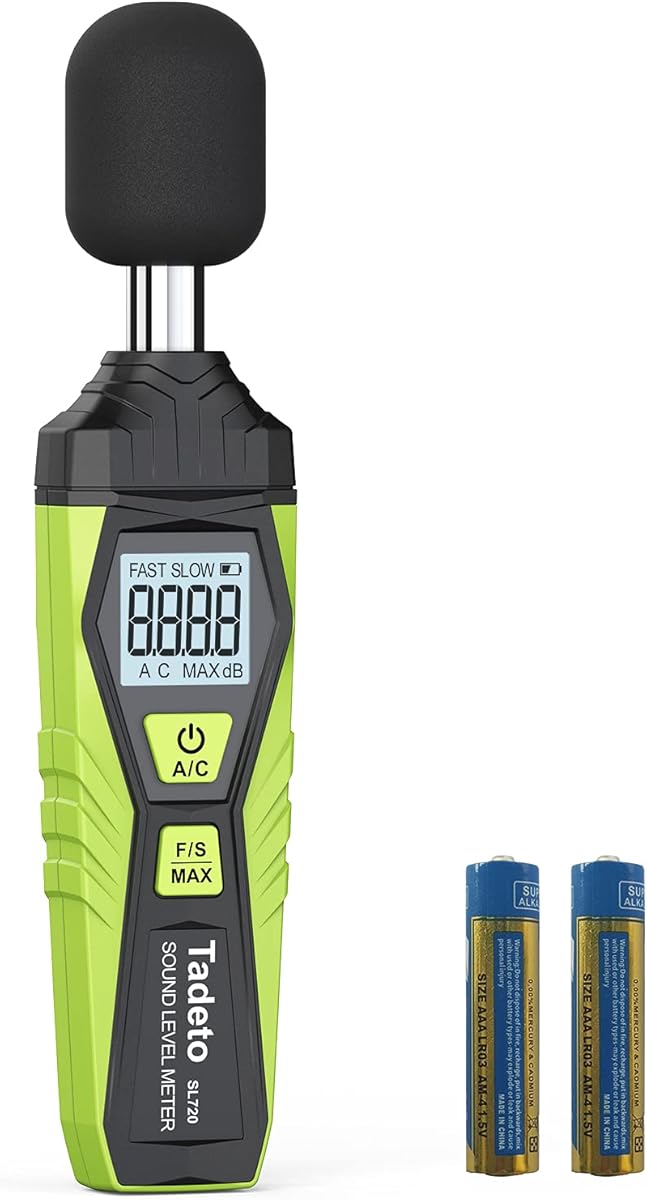
The Tadeto Digital Sound Level Meter is designed for users who prioritize portability without sacrificing core functionality. It has garnered a rating of 4.5 stars from customers who find it easy to carry around for quick checks. The device features a digital LCD display with backlight that ensures visibility in low light situations.
We may earn a commission when you buy through this link, at no additional cost to you.
Its primary strength is its ability to switch between fast and slow response rates which allows for accurate monitoring of changing noise levels versus steady state environments. The measurement range covers 30 to 130 dB with a resolution of 0.1 dB providing precise data for various applications. This makes it a great tool for home and office use where simplicity is key.
The casing feels slightly less robust compared to other models which means it should be handled with care to avoid damage. It also lacks additional sensors like temperature or humidity which limits its utility for comprehensive environmental monitoring. However for basic sound level tracking it performs admirably well within its intended scope.
We suggest this meter for anyone needing a portable solution for occasional noise checks in baby rooms or during events. Its lightweight design and straightforward operation make it an excellent choice for users who do not need advanced data logging features.
You can adjust the response time to capture rapid changes in noise or average out fluctuations for a stable reading.
The compact size allows you to keep it in a pocket or bag so you can measure sound levels anywhere instantly.
We may earn a commission when you buy through this link, at no additional cost to you.
The DURFICST Sound Level Meter distinguishes itself with a vivid LCD color screen that enhances readability and visual feedback. It holds a strong 4.6 star rating from users who appreciate the clarity of its display. This model supports both dB and SONE units offering flexibility in how noise intensity and perceived loudness are reported.
We may earn a commission when you buy through this link, at no additional cost to you.
Its high precision sensor captures sound across a wide frequency range ensuring reliable data for home and work environments. The inclusion of a windbreak ball helps reduce measurement errors caused by wind when using the device outdoors. This feature adds a layer of professional utility often missing in entry level meters.
The color screen is visually appealing but it consumes more battery power than standard LCDs requiring more frequent battery changes. The device is also slightly heavier than some competitors which might matter for extended handheld use. Despite these minor points the build quality and feature set remain highly competitive.
This meter is recommended for users who want a visually engaging interface and outdoor capability without paying for industrial grade tools. It suits musicians and home audio enthusiasts who need accurate readings in varied environments.
The color display makes it easier to distinguish between different measurement modes and alarm indicators at a glance.
Switching to SONE mode provides a better understanding of perceived loudness which is useful for acoustic adjustments.
We may earn a commission when you buy through this link, at no additional cost to you.
The Goldeep SL750A is a high value decibel meter that has achieved an impressive 4.7 star rating from satisfied users. It offers essential features like A and C weighting alongside a measurement range suitable for most common scenarios. The bright orange casing makes it easy to spot and the anti-slip grip ensures a secure hold during use.
We may earn a commission when you buy through this link, at no additional cost to you.
Its key strength is delivering reliable performance at a very accessible price point making it ideal for budget conscious buyers. The device supports both dB and SONE units which adds versatility for different types of noise analysis. It is well built for general use in homes offices and small workshops.
Some users note that the feature set is basic compared to more expensive models which means it may lack advanced customization options. There are also occasional reports about inconsistent backlighting depending on the production batch. These issues do not significantly impact core accuracy but they are worth noting before purchase.
We recommend this meter for those seeking an affordable entry point into noise monitoring. It provides sufficient accuracy and functionality for everyday tasks without requiring a significant investment.
The non-slip surface ensures that the meter stays in your hand even when moving around to take measurements.
You get professional grade weighting modes and solid build quality without the higher price tag of premium models.
We may earn a commission when you buy through this link, at no additional cost to you.
The Green variant of the TopTes TS-501B adds environmental monitoring capabilities to the core sound measurement features. It maintains the strong 4.5 star rating of its orange counterpart while offering temperature and humidity readings. This makes it a more comprehensive tool for assessing workplace conditions beyond just noise levels.
We may earn a commission when you buy through this link, at no additional cost to you.
Its accuracy and display quality match the original model ensuring reliable SPL readings. The three year warranty and lifetime technical support add significant peace of mind for buyers investing in this device. These factors make it a robust choice for industrial or academic settings where multiple environmental factors matter.
The inclusion of sensors requires more battery power so you may need to replace batteries more often than with standard models. The price is also slightly higher than the basic version which might be a consideration for those who only need sound data. However the added data points often justify the cost.
This meter is ideal for facilities managers or researchers who need a holistic view of environmental conditions. It is a strong choice if you want to track temperature and humidity alongside noise levels in one device.
Getting temperature and humidity alongside noise levels helps you understand the full context of your environment.
A three year warranty with lifetime support ensures long term reliability and access to assistance when needed.
We may earn a commission when you buy through this link, at no additional cost to you.
The RISEPRO HT-80A is an excellent budget friendly option for basic noise monitoring needs. It has a solid 4.4 star rating from users who value its simplicity and low cost. The device features a backlit display and auto power off function that help extend battery life during casual use.
We may earn a commission when you buy through this link, at no additional cost to you.
It covers the standard 30 to 130 dB range with decent accuracy for general home and office tasks. The inclusion of a gift box package makes it a convenient choice for small projects or gifts to others interested in sound monitoring. It is straightforward to operate and requires minimal setup.
The build quality is basic and feels somewhat plastic which means it may not withstand heavy professional use. Accuracy is good for general reference but may not match higher priced models for precise calibration needs. These limitations are expected at this price point and do not detract from its utility.
We recommend this meter for students or occasional users who need a no fuss tool for checking noise levels. It is a practical solution for those who do not require advanced features or rugged construction.
The device automatically turns off after a period of inactivity to save battery power for when you need it.
You can access basic sound level measurement capabilities without spending a significant amount of money.
We may earn a commission when you buy through this link, at no additional cost to you.
The DANOPLUS Data Logger is a premium solution designed for users who need to track and analyze noise over time. It holds a 4.2 star rating and distinguishes itself with the ability to record up to 43000 data points. This allows for detailed long term monitoring that standard meters cannot provide.
We may earn a commission when you buy through this link, at no additional cost to you.
Its standout feature is the PC connectivity which lets you export data via Excel files for further analysis. The rechargeable battery and three color light alarm system add convenience and immediate feedback during use. This makes it highly suitable for professional compliance checks or detailed environmental studies.
The higher price point and the need to install PC software for data export add complexity and cost. The learning curve for connecting and analyzing data might be steep for casual users. However for those who need detailed records these steps are a necessary part of the workflow.
We recommend this meter for safety officers researchers or facilities managers who require documented noise trends. It is the best choice if data export and long term tracking are your primary requirements.
Exporting to Excel allows you to create reports and graphs to share findings with stakeholders or for analysis.
The three color light indicators provide instant visual feedback on noise levels without needing to look at the screen.
We may earn a commission when you buy through this link, at no additional cost to you.
The SW-525A is a specialized decibel meter designed for fixed installations in offices or factories. It has a 4.4 star rating and offers a large screen display that is easy to read from a distance. The wall hanging design allows you to place it securely in a strategic location.
We may earn a commission when you buy through this link, at no additional cost to you.
Its key strength is providing a stable monitoring solution that does not require holding or manual checking. The red LCD display and alarm function alert you immediately when noise levels exceed limits. This makes it useful for ongoing compliance checks where constant monitoring is required.
The device is not portable so you cannot carry it around for spot checks. It also lacks advanced features like weighting modes or data logging which limits its versatility. However for a dedicated wall mounted monitor it serves its purpose well.
We recommend this meter for environments where noise levels need constant visual monitoring. It is ideal for production floors or classrooms where a fixed reference is needed.
Hanging the unit on the wall ensures it is always positioned correctly and out of the way.
It provides a continuous readout so you can keep an eye on ambient noise levels throughout the day.
We may earn a commission when you buy through this link, at no additional cost to you.
The Tadeto Digital with Alarms is a portable meter that adds a useful audible and visual alarm system. It holds a 4.3 star rating and allows you to set thresholds to alert you when noise exceeds acceptable levels. This feature makes it helpful for quality control and safety checks.
We may earn a commission when you buy through this link, at no additional cost to you.
Its strength is the combination of a backlight display with alarm capabilities ensuring you are notified even if not looking at the device. The five adjustable measurement ranges provide flexibility for different environments. It is lightweight and easy to carry for quick checks.
Setting up the alarm thresholds requires some familiarity with the menu system which might be confusing at first. The build quality is standard and may not survive rough handling. These factors are minor but are worth considering before purchase.
We recommend this meter for users who need alerts for noise spikes without constant monitoring. It is a practical tool for maintaining safe sound levels in varied environments.
The alarm system notifies you immediately when noise crosses a set limit so you can take action.
Five measurement ranges allow you to calibrate the sensitivity for different noise environments.
We may earn a commission when you buy through this link, at no additional cost to you.
The FNIRSI FDM-02 is a modern decibel meter designed for home audio enthusiasts. It has a 4.4 star rating and features a 2 inch IPS screen with dark and light themes for easy viewing. The rechargeable battery ensures you do not need to buy replacements constantly.
We may earn a commission when you buy through this link, at no additional cost to you.
Its standout feature is the curve mode which shows 30 seconds of sound changes helping you tune speakers or subwoofers. This is useful for home theater setup and calibration. The compact design and IPS screen make it pleasant to use daily.
The battery charging time is slightly longer than some models and the alarm options are basic compared to professional units. These are minor issues that do not impact core functionality. The IPS screen does consume more power but offers better visibility.
We recommend this meter for homeowners setting up audio systems. It provides a clean interface and rechargeable convenience ideal for regular use.
The IPS screen provides excellent viewing angles and color consistency so readings are clear from any position.
Curve mode visualizes sound changes over 30 seconds which helps in aligning audio levels accurately.
We may earn a commission when you buy through this link, at no additional cost to you.
Choosing the right decibel meter depends on your specific needs and the environments where you plan to use it. This section breaks down the key factors to consider before making a purchase decision.
The measurement range indicates the lowest and highest decibel levels the device can accurately detect. Most household meters cover 30 to 130 dB which is sufficient for typical noise sources. Ensure the device meets your expected maximum noise level to avoid inaccurate readings or sensor damage.
Look for a range that matches your environment whether it is a quiet office or a noisy factory floor.
Weighting modes simulate how the human ear perceives sound frequencies. A weighting is standard for environmental and general noise while C weighting is used for high intensity mechanical sounds. Having both options adds versatility to your measurements.
Choose a meter with both A and C weighting to ensure you can measure different noise types accurately.
Response time determines how quickly the meter reacts to changes in sound levels. Fast response captures rapid spikes while slow response averages fluctuations for a stable reading. Select the response mode that fits your monitoring style.
Use fast response for traffic or impact noise and slow response for steady industrial or office noise.
A clear display is essential for reading values easily in various lighting conditions. Look for backlit screens or IPS displays that maintain visibility in low light. Larger screens are easier on the eyes during extended monitoring sessions.
Prioritize models with backlit displays if you plan to use the meter in dim environments.
Data logging allows the device to record measurements over time which is crucial for compliance and trend analysis. Not all meters have this feature so check if you need the ability to store or export data. Advanced models may include PC connectivity.
Invest in a data logging meter if you need to track long term noise patterns.
Most meters use replaceable batteries while others offer rechargeable options. Rechargeable units reduce long term costs but may take time to charge. Consider how often you use the device and battery availability.
Choose a rechargeable model for frequent use to avoid running out of battery unexpectedly.
A sturdy build ensures the device withstands regular handling and potential drops. Look for non-slip grips and protective features. Industrial use may require a more rugged casing than home use.
Check the casing quality and warranty terms to ensure the meter lasts for your intended period.
Price varies based on features and build quality. Entry level meters offer basic functionality while premium models provide advanced data and durability. Determine your budget and prioritize features that matter most to your use case.
Balance cost with required features to get the best value for your specific needs.
To use your decibel meter effectively start by turning it on and selecting the appropriate weighting mode. A weighting is generally recommended for general noise monitoring while C weighting is better for loud mechanical noise. Hold the device at ear level for the most accurate readings of what people experience.
Ensure the microphone is not obstructed by your hand or clothing which can affect sound capture. Use the hold function to freeze readings if you need to record a specific value. If your meter supports data logging review the stored data regularly to track trends.
Store your meter in a cool dry place to protect the electronics from humidity and heat. Clean the display gently with a soft cloth to maintain visibility. If it uses batteries replace them when the indicator appears to ensure continuous operation.
A decibel meter is used to measure sound pressure levels in the environment. It helps ensure compliance with noise regulations assess workplace safety and tune audio systems.
Consumer decibel meters are generally accurate enough for casual monitoring. For professional calibration use models with verified accuracy and regular calibration procedures.
Many meters include a calibration function but professional calibration requires a reference sound source. Check the manual for factory calibration steps or contact the manufacturer.
Phone apps can provide estimates but they lack hardware calibration. Dedicated meters offer more reliable results due to calibrated microphones.
A weighting simulates human ear sensitivity to low level sounds while C weighting captures high intensity noise. A is for general use C is for industrial.
Battery life varies by usage and model. Typically replaceable batteries last weeks of regular use while rechargeable units offer days to hours depending on screen usage.
Some advanced meters allow data export via USB or Bluetooth. Check if the device supports file formats like CSV for analysis.
Safe noise levels vary by duration and jurisdiction. Generally below 85 dB for extended periods is recommended to prevent hearing damage.
We have reviewed ten decibel meters that offer a range of features from basic monitoring to advanced data logging. The TopTes TS-501B leads as the best overall choice for its balance of accuracy and usability.
Prioritize the features that matter most to your specific needs such as data export or environmental sensing. For budget friendly options the RISEPRO HT-80A remains a solid entry point for casual users.
Prices and availability change frequently so verify current details on the product pages before buying. This guide aims to help you make an informed choice for your noise monitoring needs.