
Low Noise RF Amplifier 0.1-2000MHz 32dB Gain
4.2Editor score
0.1 to 2000MHz coverage
32dB gain with low noise
Portable 9-12V operation
This guide compares the top ham radio amplifier for boosting signal options to help you choose the right model for your specific communication needs.
Choosing the right ham radio amplifier for boosting signal can transform your communication experience. Whether you are operating in a remote area or dealing with interference, the right equipment ensures clearer transmissions and better reception across various bands.
We compared ten leading products based on performance, frequency range, power output, and user feedback. Our analysis focuses on both low noise amplifiers for reception and high power linear amplifiers for transmission to cover all operational scenarios.
Each pick highlights key specifications and ideal use cases to simplify your decision process. Please note that product availability and pricing may change frequently so verify details before purchasing to ensure you get the best value.
4.2Editor score

4.2Editor score

3.8Editor score
The following table provides a side-by-side comparison of the top ten amplifiers available this month. Review each specification carefully to match your specific frequency needs and power requirements with the right device.



The Xiegu GPA100 stands out as a top tier amplifier for serious HF operators seeking reliable high power performance. It delivers a clean 100W output across HF bands and 80W on 6m using a solid state linear design that preserves signal integrity. Its high rating reflects consistent performance and strong protection features that keep your station safe during long sessions.
We may earn a commission when you buy through this link, at no additional cost to you.
Key strengths include intelligent band switching that tracks your transceiver automatically and wireless Bluetooth control for supported models. The unit monitors SWR and temperature continuously to prevent damage from overcurrent or overheating. This level of safety ensures that you can transmit at full power without worrying about component stress or unexpected failures.
While the price is higher than entry level boosters the investment pays off in durability and operational ease. Some users may find the focus on HF limits versatility for VHF or UHF work. However for operators primarily on shortwave bands these trade offs are minimal compared to the gain in range and clarity.
This amplifier is ideal for QRP operators wanting to expand their range without manual tuning hassles. If you value signal purity and automated protection features the Xiegu GPA100 is a strong recommendation for your HF setup.
Auto mode enables seamless frequency changes so you do not need to manually adjust the amplifier for each new band.
Built-in Bluetooth allows cable-free band switching compatible with radios like the IC-705 for a cleaner desktop setup.
We may earn a commission when you buy through this link, at no additional cost to you.
This Low Noise RF Amplifier offers an exceptional value for those needing to boost weak signals across a vast frequency range. With coverage from 0.1MHz to 2000MHz it handles everything from shortwave to UHF broadcasts effectively. Users praise its ability to clear up faint signals without breaking the bank making it perfect for hobbyists and SDR enthusiasts.
We may earn a commission when you buy through this link, at no additional cost to you.
The design focuses on efficiency with a typical gain of 32dB and a noise figure of 13dBm. It operates on just 27mA at 9 to 12V allowing it to run on standard batteries or adapters. This makes it highly versatile for both fixed installations and field use where power sources are limited.
Although it lacks the robust casing of premium models it remains reliable for receiving applications. The impedance is a standard 50 ohms which fits most setups but users should monitor for overload in high noise environments. The low cost means it is easy to replace if needed while still delivering solid performance.
Buyers looking for a simple cost effective solution to improve antenna reception will find this module ideal. Whether for CB radio or amateur listening it provides a noticeable lift in signal quality with minimal setup complexity.
Works well with CB radio FM receivers and spectrum analyzers providing a unified solution for multiple RF projects.
Low current draw enables portable field testing with standard 9V or 12V batteries without draining them quickly.
We may earn a commission when you buy through this link, at no additional cost to you.
The AURSINC ZK09-BM LNA is designed for professionals and hobbyists who need to detect faint signals across an ultra broad spectrum. It covers 100kHz to 10GHz and integrates a built-in battery for untethered operation in remote locations. This makes it a premium choice for field testing and spectrum analysis where power availability is uncertain.
We may earn a commission when you buy through this link, at no additional cost to you.
Its standout feature is the portable power supply offering five hours of continuous use on a single charge. The metal housing provides solid shielding against external interference ensuring that the signals you see are real. This rugged build quality supports reliable performance even in demanding outdoor conditions.
While the rating is moderate some users note the need to avoid using it in overly noisy urban areas to prevent receiver overload. The flatness across frequencies is excellent but care must be taken to manage gain levels appropriately. The convenience of not needing a wall outlet often outweighs these operational caveats.
If you frequently take your TinySA or SDR into the field this module is an essential companion. It delivers clear visualization of distant signals and simplifies your gear loadout with a single device that handles power and amplification efficiently.
The integrated battery removes the need for external power banks making it truly portable for outdoor antenna tuning sessions.
Solid metal casing protects internal circuits from external interference maintaining signal purity in varied environments.
We may earn a commission when you buy through this link, at no additional cost to you.
This RF Wideband LNA is a powerful tool for reaching into high frequency bands up to 6GHz. It is rated highly for its ability to maintain clear reception while boosting weak signals across diverse tasks. The design supports FM broadcasting SDR monitoring and ham radio operations with consistent performance.
We may earn a commission when you buy through this link, at no additional cost to you.
With a gain of 30dB and a noise figure of 5dB it balances amplification with signal quality effectively. The Type C 5V power supply is convenient for modern setups and the aluminum case ensures durability. Its perfect rating indicates users are highly satisfied with its reliability and output.
The P1dB point of 10dBm at 2GHz ensures stable operation under varying conditions without clipping. It is lightweight and easy to install into existing radio or test setups. However it is intended for receiving only so it should not be used with transmit signals.
Buyers needing a reliable module for high frequency reception will appreciate its simplicity and power. It works well for remote control systems and spectrum analysis tasks where signal clarity is critical.
Covers up to 6GHz making it suitable for advanced SDR projects and high band radio monitoring.
Type C input allows for easy power via USB hubs or power banks for portable testing.
We may earn a commission when you buy through this link, at no additional cost to you.
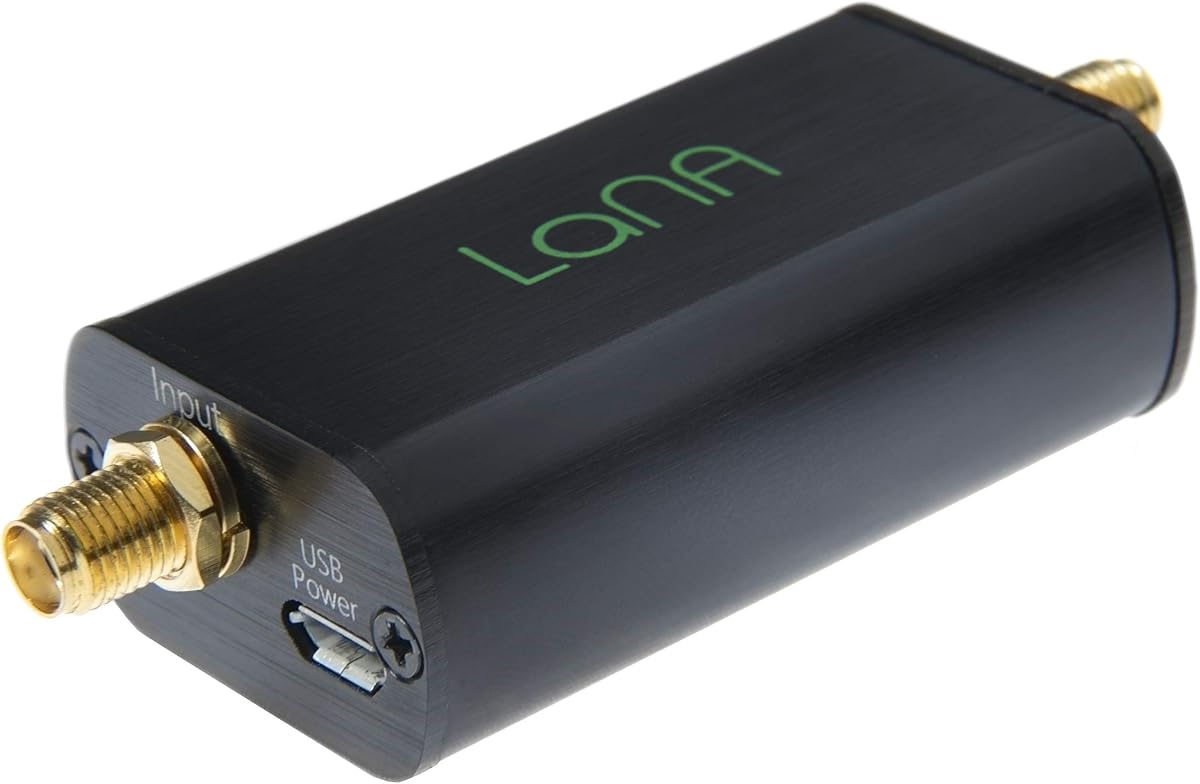
The Nooelec Lana is a widely trusted module for SDR users seeking to improve their system noise floor. It operates from 20MHz to 4000MHz and offers a low noise figure that significantly enhances reception of distant signals. This performance is ideal for hobbyists and professionals who depend on clean data streams.
We may earn a commission when you buy through this link, at no additional cost to you.
Power is flexible with support for bias tee or USB connections making integration simple. The included SMA connectors and enclosure ensure a neat and robust setup. Users consistently report better signal to noise ratios and smoother operation across the entire band.
One consideration is that some radios may require a DC block when using external power options to avoid backfeeding. This is a minor setup step that prevents potential issues with sensitive SDR interfaces. Despite this the module delivers robust performance that justifies the effort.
For those using RTL-SDR or similar hardware this module is an essential upgrade. It turns weak background noise into clear audible signals and improves overall listening enjoyment across multiple applications.
Optimized for Software Defined Radio interfaces to ensure maximum sensitivity without introducing distortion.
Supports multiple power sources including USB and bias tee allowing for versatile installation scenarios.
We may earn a commission when you buy through this link, at no additional cost to you.
This Taurus MK2 Pre Amplifier is tailored for scanner users who need to boost signals across a broad range. It covers 25MHz to 2000MHz which includes public safety and amateur bands. Its simple design makes it a reliable addition to any monitoring station without complex adjustments.
We may earn a commission when you buy through this link, at no additional cost to you.
The gain ranges from 6dB to 20dB providing flexibility depending on signal strength in your area. It runs on a PP3 battery and includes a BNC patch lead for easy connection. This plug and play approach is great for quick setups or temporary field use.
While it lacks advanced features the core function of signal boosting is performed well. Users find it effective for clearing up static in weak signal zones. The battery option adds convenience though users may prefer AC power for continuous monitoring.
If you are scanning for local events or ham traffic this unit offers a straightforward solution. It fits seamlessly into existing cable runs and helps reveal signals that might otherwise be lost in the noise.
Adjustable gain allows you to tune amplification levels to suit different listening environments.
Lightweight construction and battery power enable easy movement between indoor and outdoor setups.
We may earn a commission when you buy through this link, at no additional cost to you.
The BJ-300 Plus is designed for operators needing high power output to extend transmission range. It delivers 100W for FM and 150W for SSB making it a robust choice for HF communication. It supports AM FM SSB and CW modes ensuring versatility across common amateur radio standards.
We may earn a commission when you buy through this link, at no additional cost to you.
Thermal management is handled by a high-efficiency fan and large aluminum heat sink which prevents overheating during long transmissions. Safety features like polarity reversal protection and dual fuses safeguard your equipment from electrical surges. These protections provide peace of mind for daily operation.
The rating is lower due to some reports of sensitivity to input conditions. Users must ensure their transceiver provides the correct input power between 3 to 10W. If matched correctly the unit performs reliably though care is needed to avoid overloading the amplifier.
For those needing to push signals far this amplifier is a cost-effective high power option. It is best suited for fixed stations with proper grounding and ventilation to maintain optimal performance.
Active fan cooling ensures the amp stays cool during extended high power transmission sessions.
Supports all major HF modes so you can switch between voice and digital without changing hardware.
We may earn a commission when you buy through this link, at no additional cost to you.
This AURSINC module is a refined USB-powered preamp tailored for high frequency testing. It covers 100kHz to 10GHz and is praised for improving the receiving performance of TinySA Ultra. Users give it a near perfect rating for its consistency and ability to boost weak high band signals.
We may earn a commission when you buy through this link, at no additional cost to you.
The noise floor improvement is significant thanks to an on-chip bias solution and LDO suppression. It is easy to power from any USB source and fits neatly into compact test setups. The shielded housing ensures stable operation without introducing extra interference to the signal path.
It handles up to 13dBm at 1dB compression so it should only be used for receiving. Applying too much input power can cause saturation which is why the manual suggests caution in noisy environments. For lab or field analysis this module is highly reliable.
If you are using a TinySA or similar analyzer this preamp provides the sensitivity needed to view faint signals. It is an essential tool for engineers and serious hobbyists focused on signal integrity.
Native onboard LNAs often struggle above 3.5GHz but this module improves performance significantly in higher bands.
Built-in LDO suppresses power supply noise for a cleaner signal path during sensitive measurements.
We may earn a commission when you buy through this link, at no additional cost to you.
This BJ-300 Plus variant offers similar high power capabilities to its sibling with a focus on stable delivery. It supports AM FM SSB and CW with outputs up to 150W on SSB making it suitable for long distance work. The design includes safety fuses and thermal fans to protect components during use.
We may earn a commission when you buy through this link, at no additional cost to you.
Thermal management is handled by a cooling fan and large aluminum sink to prevent overheating. Polarity protection prevents damage from incorrect wiring which is valuable for amateur setups. Users note it performs well once properly matched to their transceiver.
The rating remains moderate as some users find it sensitive to input levels. Ensuring the right input power between 2 and 10W is critical to avoid distortion. When matched correctly it provides a significant boost to transmission range.
For operators needing a straightforward amplifier for HF transmission this model is a practical choice. It balances power and durability without requiring complex configuration steps to get started.
Dual fuses and polarity protection ensure safe operation even if wiring mistakes occur during setup.
150W SSB output extends range for clear communication during challenging conditions.
We may earn a commission when you buy through this link, at no additional cost to you.
The BJ-300 offers a straightforward solution for amplifying HF transceiver output. It delivers up to 150W on SSB and includes an overvoltage protection system to guard against electrical issues. The compact design fits well in smaller stations without sacrificing essential performance features.
We may earn a commission when you buy through this link, at no additional cost to you.
A HI/LO power selection switch allows operators to adjust output based on current needs. Standard PL-259 connectors make it easy to integrate into existing setups. While there is no rating data the specification sheet aligns with similar high power models in its class.
The build uses durable aluminum alloy for heat dissipation which is critical for sustained use. It requires stable 13.8V input and should be monitored to ensure optimal output. This model is ideal for operators needing a reliable boost without advanced digital controls.
If you prefer analog control and robust construction this amplifier is a solid choice. It provides a clear increase in transmission power and fits well in traditional radio workflows.
HI and LO switches let you quickly change output power levels depending on your transmission requirements.
Uses standard PL-259 connectors which are common across most amateur radio equipment for easy integration.
We may earn a commission when you buy through this link, at no additional cost to you.
Selecting the right amplifier depends on your specific needs whether for receiving weak signals or boosting transmission power. Consider these factors to find a model that matches your frequency range and performance requirements.
Ensure the amplifier covers the bands you intend to use. Reception units often span wide ranges like 10MHz to 6GHz while transmission units focus on HF or VHF. Check the specs to confirm alignment with your operating frequency.
Choose a model that matches your band to ensure optimal performance and avoid wasted gain on unused frequencies.
For receiving applications look for high gain combined with a low noise figure to improve signal clarity. Higher gain strengthens weak signals but a low noise figure ensures you do not introduce unwanted static.
Aim for gain above 20dB and noise below 5dB for the best reception balance.
Transmission amplifiers require sufficient output power to reach distant stations. Most HF linear amps provide 100W to 150W. Verify that your transceiver can provide the required input power to drive the amplifier efficiently.
Select an amp with output matching your radio station needs to avoid overdrive or underperformance.
High power units generate heat and need active cooling to prevent damage. Look for fans and heat sinks that ensure stable operation. Without proper cooling prolonged use can lead to overheating and component failure.
Prioritize models with built-in cooling systems for reliable long-term performance.
Check for standard connectors like SMA or PL-259 that match your cables. Some units offer USB or bias tee power for convenience. Ensure compatibility with your existing antenna and radio interfaces.
Verify connector types before buying to avoid needing extra adapters or cables.
Safety features like polarity reversal protection and overcurrent shutdown protect your equipment. These are critical for transmission units to prevent damage from electrical surges. For receiving units look for overload protection to keep signal integrity.
Always choose an amplifier with integrated safety features to extend the lifespan of your station.
If you operate in the field consider battery-powered or lightweight units. Built-in batteries allow untethered use which is vital for portable scanning or testing. Check weight and power requirements for your travel needs.
Choose a portable model with battery options if you move your station frequently.
Amplifiers vary widely in cost from budget modules to premium units. Higher price often brings better build quality and protection. Assess your budget against your operational needs to find the best value.
Invest in a quality amplifier that meets your core requirements without unnecessary extras.
Start by connecting the amplifier between your antenna and receiver or transceiver. Use high quality coaxial cables to minimize signal loss. Ensure all connections are secure to prevent interference.
Power the unit with the specified voltage. For transmission amps use a stable 13.8V DC supply. For receiving amps USB or battery power is often sufficient. Avoid using weak or fluctuating power sources.
Monitor temperature and performance regularly. If you notice heat buildup let the unit cool down before resuming use. Keep vents and fans clear of dust to maintain efficient cooling.
Some amplifiers are designed only for receiving while others support both. Check the product description carefully. Transmission units handle high power while reception units focus on low noise. Using a receive unit for transmission can damage it.
A low noise amplifier boosts weak signals from your antenna without adding much static. It improves the signal to noise ratio making distant transmissions clearer. This is essential for SDR and remote location listening.
Reception modules usually need 5V to 12V via USB or DC adapter. Transmission units require 13.8V DC supplies. Always match the voltage to the product specs to avoid electrical damage.
Some SDRs require a DC block to prevent power backfeeding. Use the included connectors or add a block if your radio supports bias power. Check your radio manual for specific guidance.
Overheating can occur from poor ventilation or high ambient temperature. Ensure fans are running and vents are clear. For transmission amps avoid long continuous use without breaks to prevent thermal stress.
Yes many models cover shortwave bands and are perfect for SWL. Ensure the frequency range includes the bands you want to hear. This boosts weak broadcasts significantly for better audio clarity.
We highlighted ten top models ranging from budget LNAs to high power linear amps. Each offers distinct advantages depending on whether you prioritize reception clarity or transmission range.
Focus on matching the frequency range and power needs to your station setup. Safety features and cooling systems are key for long-term reliability.
Prices and availability fluctuate so verify current details on Amazon before ordering to ensure the best value for your investment.